cache-stats is published by Arafat Tehsin from arafattehsin/cache-stats-extension, pinned to a6d6e0c2cb3c4309794dcc712cd14906b2b297db. Review the source before installing.
A local-first GitHub Copilot canvas for understanding prompt-cache reuse, expiry, token composition, and AI Credit cost while a session is still active.
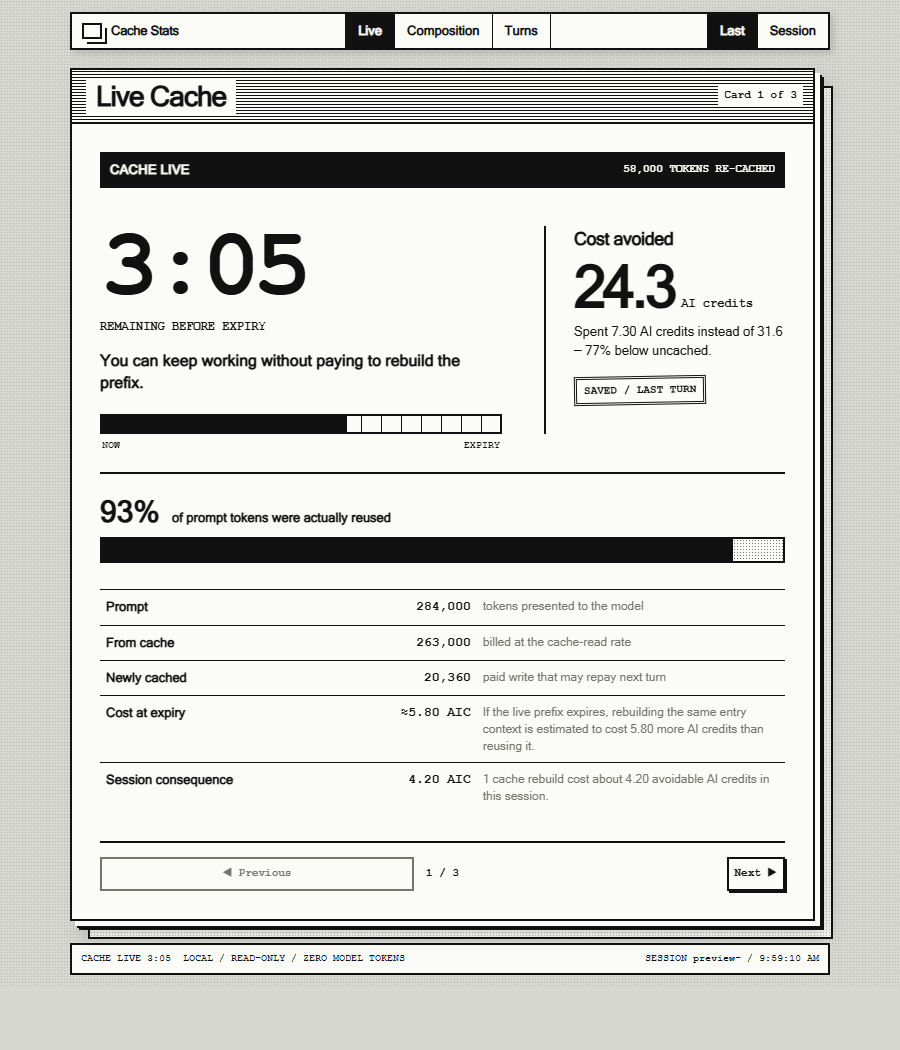
Preview data is illustrative and does not contain session information.
The one-bit HyperCard stack has three focused views:
- Live Cache shows expiry state, reuse, and the cost exposed if the reusable prompt prefix must be rebuilt.
- Composition separates fresh input, cache reads, cache writes, output, and reasoning tokens.
- Turn History makes cold starts and rebuild costs visible turn by turn.
The canvas refreshes locally every two seconds. Opening and using it consumes no model tokens.
Install
In a GitHub Copilot session, ask:
Install this extension: https://github.com/arafattehsin/cache-stats-extension
Then ask:
Open the cache stats canvas
Before marketplace approval, install the public repository directly:
copilot plugin install arafattehsin/cache-stats-extension
After marketplace approval, install it from Awesome Copilot:
copilot plugin install cache-stats@awesome-copilot
Requirements
- A GitHub Copilot client with canvas-extension support
- A Node.js runtime with the built-in
node:sqlitemodule - A local Copilot session store containing
assistant_usage_events
Privacy
Cache Stats reads ~/.copilot/session-store.db in read-only mode and serves the
canvas from an ephemeral 127.0.0.1 port. It does not modify the session store,
call a model, load remote assets, or send telemetry.
The local canvas API includes the active session ID and database path in its response for diagnostics. That endpoint is available only through the loopback server created for the open canvas instance.
How the numbers work
input_tokens is the complete prompt for one model call:
fresh input = input_tokens - cache_read_tokens - cache_write_tokens
Per-token billing rates come from each row's token_details_json, so baseline
cost, actual cost, savings, and rebuild exposure follow the model that served
the call instead of relying on hard-coded prices. Costs are shown in AI Credits
(AIC), converted from the store's nano-AIU values at 1 AI Credit = 1e9 nano-AIU.
A turn starts with one user-initiated call and includes its agent, sub-agent,
and compaction follow-ups. A turn is marked REBUILT when its entry call reads
no cached prefix but writes a substantial one. Live expiry comes from Copilot's
session.usage_checkpoint event, using the cache entry for the model the main
conversation called last.
Development
npm install
npm run check
copilot plugin install .
Reinstall the local plugin after changing source files because Copilot caches installed plugin content.
Package layout
| Path | Role |
|---|---|
plugin.json |
Agent Plugins v1 manifest and Copilot catalog metadata |
copilot-extension.json |
Direct canvas-extension install metadata |
extension.mjs |
Direct-install bridge to the packaged extension |
com.github.copilot/extensions/cache-stats/ |
Spec-namespaced canvas extension package |
assets/preview.png |
Anonymized catalog preview |
scripts/ |
Package and embedded-UI checks |
docs/PUBLISHING.md |
Public release and Awesome Copilot submission guide |
Environment overrides
COPILOT_CACHE_STATS_DB- explicit path to the session storeCOPILOT_HOME- alternate Copilot home directory